Closing a clothing store is usually a one-time event, and ideally one without any surprises. Three things need to be cleared out: the inventory, the fixtures, and ultimately yourself—all out of the premises. In 2026, chains like IKKS and Paprika went bankrupt in Belgium and closed dozens of stores, but most businesses that shut down are small boutiques. This article is for them.
You'll learn the best order to work in, the rules that apply to a sale and to giving away clothes, and how much it costs to clear out your closet.
Short answer: Start with the date by which the property must be vacated and work backward. Sell as much as possible first: a closing-down sale may last no longer than 5 months. Have whatever remains hauled away. Donating items tax-free to a recognized charity is only permitted under strict conditions. Have the shelves, the counter, and the built-in fitting rooms removed last. This is usually done in a single day, with a proof of removal for your landlord.
1. Start with the date of the property
It all depends on the date you return the keys. Under a commercial lease, you, as the tenant, may terminate the lease at the end of each 3-year term. You must give at least 6 months’ notice, either by registered letter or through a bailiff.
Would you like to end the lease early? This is only possible by mutual agreement with the landlord. This agreement must be formalized in a notarial deed or in a declaration before a justice of the peace.
Once that date is set, you can work backward: How much time do you have to sell everything, and when does the store actually need to be empty?
2. Sell First: The Sale
A clearance sale due to business closure is permitted. However, there are a few rules that apply:
- If you close your business, you must sell your entire inventory. If you are closing only this store, you must have operated it for at least one year.
- You may only sell items that were already in stock before the sale began. You may not order new stock specifically for the sale.
- The liquidation will last up to 5 months. If you are ceasing operations because you are retiring, the period is 12 months.
- There must not have been any sales for the same reason in the past 3 years.
- Each announcement includes the start date.
- If you announce a discount, the "previous price" is the lowest price you charged in the 30 days prior.
- You sell in your own store. Selling at another location is only permitted with an exemption from the Federal Public Service Economy.
- You no longer need to report the sale to the FPS Economy, but in the event of an inspection, you must be able to demonstrate that you meet all the requirements.
A sale is also allowed during the blackout period, which is the month before the sales. Is your store’s closing date around January? In 2027, the winter sales will run from January 2 through January 31: January 3 falls on a Sunday, so they’ll start a day earlier. That’s often the last chance to sell a lot of inventory all at once.
Will there still be a large batch left after the sale? If so, ask outlets and thrift stores if they’re interested. Also, review your agreements with brands: some suppliers have rules about where their clothing can be sold.


The warehouse of a clothing store at one of our job sites: shelves full of folded clothing and racks of coats.
3. What’s Left: Donating Without VAT?
Donating clothing and shoes to a charity is exempt from VAT, but only under strict conditions. The rules are set forth in Royal Decree No. 59. The FPS Finance explains them in Circular 2026/C/22 of January 2026. Clothing and shoes are included on the list, with the exception of shoes intended primarily for sports.
The terms and conditions:
- For legal reasons, the clothing can no longer be sold normally. For example: the packaging is damaged, the item does not meet the manufacturer’s standards (such as a color defect), or the regular sales period has ended, as is the case with items for Christmas or Sinterklaas. Regular remaining inventory after a sale does not automatically fall under this category.
- The recipient is a public social welfare center (OCMW) or another government agency that distributes aid, a charity recognized by a government agency, or a distribution platform recognized by the Federal Public Service (FPS) Finance. The recipient agrees not to sell the clothing but to give it to people in need. A thrift store resells goods and is therefore not normally included in this provision.
- You should prepare a donation document in duplicate, dated and co-signed by the recipient. This must be done no later than the 15th of the month following the gift.
If all conditions are met, you will not owe VAT on the donation and you will retain the VAT you claimed as a credit at the time of purchase. If that is not the case, you will still owe VAT on that donation. Therefore, discuss this with your accountant first. Also ask how to account for the inventory you’re writing off for VAT purposes.
4. Are you still allowed to destroy clothing?
As of July 19, 2026, large companies in the EU are no longer allowed to destroy unsold clothing, accessories, and shoes. For medium-sized companies, this rule takes effect on July 19, 2030. Small and micro-enterprises are exempt: those with fewer than 50 employees and a maximum of €10 million in revenue or total assets. Most boutiques are therefore not subject to this rule.
Still, throwing things away is rarely the best choice. Clothing that’s still in good condition can get a second life at a thrift store or secondhand shop, and it saves you money on waste disposal fees.
5. The layout: racks, counter, and fitting rooms
A clothing store is full of items that don’t fit in a regular trash bag: clothing racks, wall systems, display fixtures, the counter, the cash register counter, mirrors, and mannequins. And then there are the boxes, hangers, and plastic covers from the warehouse.
- Could the next tenant use this? Ask your landlord. A new tenant may want to keep the counter or the fitting rooms. Always put such an agreement in writing.
- What's included, such as fitting rooms, fixed racks, or floor coverings, often need to be removed if your lease agreement requires you to return the property to its original condition. We also handle that removal, including the disposal of debris. It’s listed as a separate line item on the same quote.

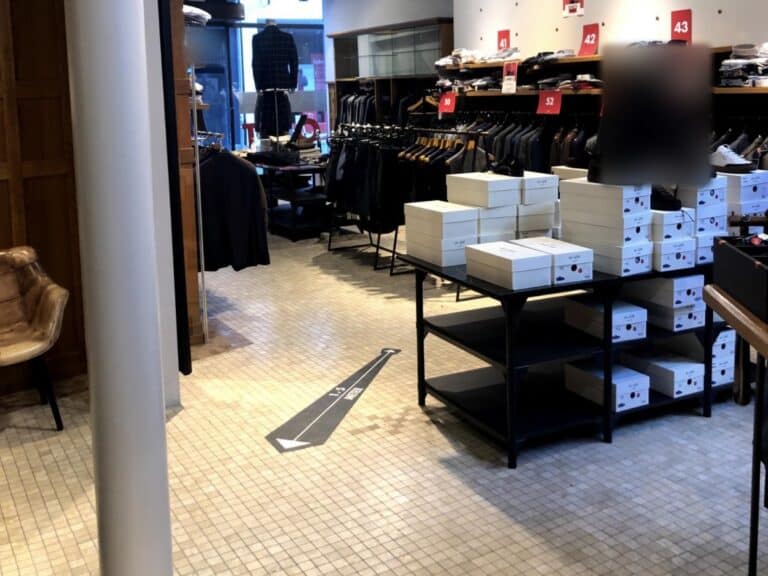
Racks, wall systems, and a display table: there’s much more to a clothing store than just clothes. Photo from a project for a client.
Please note: Anything that comes from your store is considered commercial waste. In Antwerp, you are not allowed to take this type of waste to the city’s recycling centers. You can read more about this in our article on Commercial Waste as a Self-Employed Person in Antwerp.
6. What Happens to the Things We Bring With Us
We do not purchase leftover inventory. However, we do sort everything we take with us:
- We donate usable clothing, shoes, and home furnishings to thrift stores and secondhand shops in the region, such as De Kringwinkel and Opnieuw & Co.
- The rest goes to certified processors.
You will receive an official receipt for the disposal. This is useful for your landlord, your accountant, or a trustee.
7. How much does it cost to clear out a clothing store?
Estimated prices for the city of Antwerp, including handling, transportation, and disposal fees, excluding VAT:
A medium-sized store typically costs between €700 and €1,500. Additional charges apply only when applicable: stairs without an elevator, €20 per floor; ladder lift, up to €80 per hour; unloading more than 10 meters from the door, €115; outside Antwerp, €30 to €150. You’ll always receive a fixed price before we start, based on photos. All details are listed on our prices page.
8. Your Schedule at a Glance
Frequently Asked Questions
Do I need to be there when you're clearing out the store?
No. One key is sufficient—you can get it from the landlord or a neighbor, for example. You will always receive proof of removal, and photos of the empty store are available upon request.
How soon can you come?
Usually within 2 to 5 business days. In urgent cases, such as a bankruptcy, we try to complete the process within 48 hours (+30%).
Will you buy up my remaining stock?
No. We'll take it with us and donate usable clothing to thrift stores and secondhand shops. If you'd like to recoup some of the cost, try selling it yourself first at a garage sale or an outlet store.
Do you also work for trustees?
Yes. We follow the timeline of the case and submit the discharge document for the bankruptcy. Read more about bankruptcy clearance.
Are you closing your business? We'll clear out the store
- Fixed price upfront, based on photos
- Shelves, display counter, fitting rooms, and remaining inventory—all gone at once
- Usable items to thrift stores and secondhand shops
- Official proof of disposal for your landlord or trustee
- Photos via WhatsApp or the form: between 7 a.m. and 9 p.m., a quote within 2 hours
You can read more about our approach at clearing out a clothing store. Would you rather call? Give us a call at +32 469 63 55 62.