Cabinets full of old invoices, personnel files, or client folders: every business and every self-employed professional has them, as do many individuals. These documents can’t simply be thrown in with the recycling, because they often contain personal information.
In this guide, you'll learn which documents you need to keep, how to securely destroy paper, and what a destruction certificate is.
1. What documents do you need to keep?
Do not destroy anything until the statutory retention period has expired. The most important time limits in Belgium:
- Tax documents (invoices, contracts, supporting documents): 10 years. This has been the case since the law of November 20, 2022, effective for the 2023 tax year.
- Accounting under economic law: 7 years. In practice, you should use the longest term.
- Social Documents, such as the personnel records and individual accounts: 5 years (FOD WASO).
- Personal Information: in accordance with the GDPR, no longer than necessary (Data Protection Authority).
The period usually begins on January 1 of the year following the date of the document. If you’re unsure, check with your accountant or payroll service.
2. When do you organize your archives?
- Annually: a regular cleanup process for documents whose retention period has expired.
- When moving or renovating: See also our Checklist for Clearing Out an Office.
- In the event of cessation of business or bankruptcy: Read more about bankruptcy clearance.
- After a death: if the deceased's papers need to be sorted through. Read our guide.
3. Shredding Paper Yourself: What Works and What Doesn't?
Paper Shredder
For small quantities, a good paper shredder will suffice. Choose one that produces confetti-style shreds rather than long strips. The DIN 66399 standard classifies paper shredders into security levels. For personal data, at least level P-4 is usually recommended. However, this can be time-consuming for an entire archive.
Shredding Paper with Water
You can soak a few sheets in water until they fall apart, and then dispose of the wet pulp with the general waste. That works for a handful of papers, but not for an archive: it’s slow and messy, and you have no proof of destruction. Never add chemicals: that’s dangerous, and that wastewater must not be discharged into the sewer system.
Burning
Burning paper in the yard or in a stove is prohibited in Flanders. You are not allowed to burn trash outdoors, nor are you allowed to burn trash in a wood-burning stove (VMM).
Paper Bin
Confidential documents do not belong in the regular paper recycling bin or with the scrap paper: anyone can access them there.
4. Having Records Destroyed: Here's How It Works
For larger quantities, it’s best to have the records destroyed by a professional. Here’s how it works at JunkBrothers:
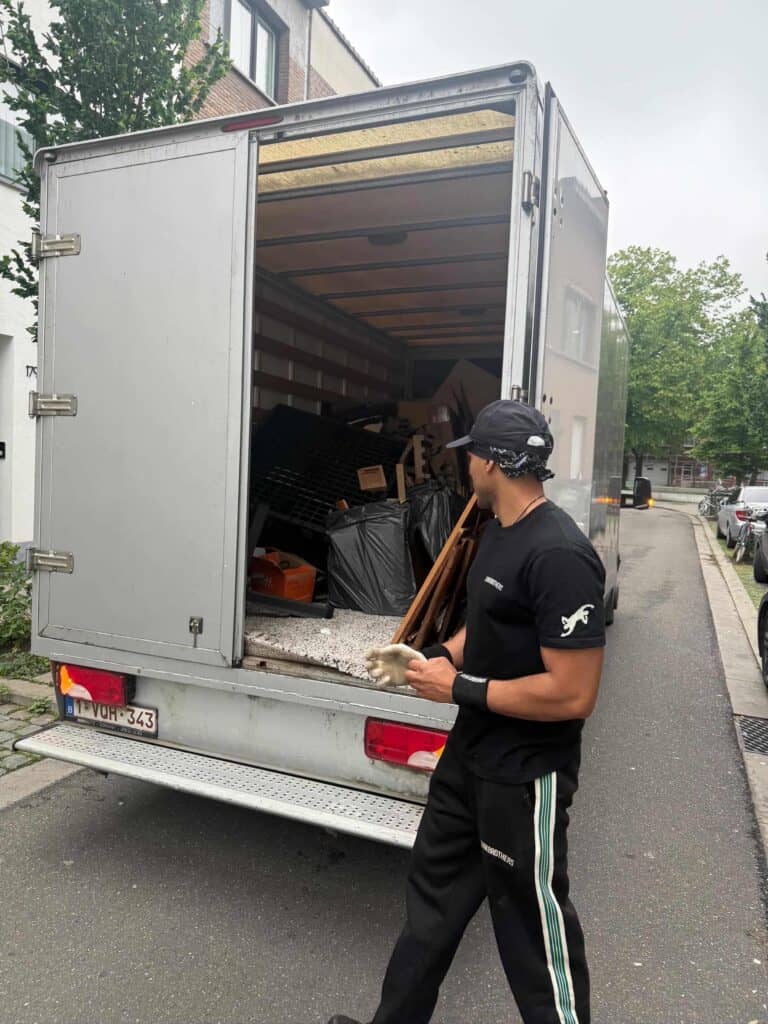
- We'll pick up your archives—whether they're at your home or office, even if they're in the basement or attic.
- Upon request, we’ll also take the empty filing cabinets and shelves with us.
- The paper is shredded by a certified shredding partner.
- You will receive a certificate of destruction as proof.
This can be done once, for example when moving, or as part of a corporate clearance. We also serve individual customers.
5. What is a certificate of destruction?
A certificate of destruction is official proof that your documents have been securely destroyed. It specifies when and how the destruction took place and the quantity involved. Keep it in a safe place: that way, in the event of an audit or a customer inquiry, you can demonstrate that you have handled personal data properly.
6. What about digital data?
Hard drives, USB flash drives, and old laptops often contain confidential data as well. Have them erased using specialized software, or physically destroyed by a certified company. We do not destroy data storage devices ourselves: during a clearance, we set them aside so that you can hand them over to a certified data destruction service.
Checklist: Organizing Your Archives
- ☐ Retention periods reviewed (10 years for tax purposes, 5 years for social security purposes)
- ☐ Documents sorted: keep or destroy
- ☐ Small quantities using a paper shredder (at least P-4)
- ☐ No paper was burned, and nothing confidential was included with the paper recycling
- ☐ Arrange for larger quantities to be picked up and destroyed
- ☐ Certificate of destruction received and retained
- ☐ Data storage media kept separate
Want to have your records destroyed?
Please let us know approximately how many boxes or cabinets there are. You'll receive a fixed price and a certificate of destruction upon completion.
Request a free quotePrefer to call? Give us a call at +32 469 63 55 62.